

What divides left and right in politics today?
Expected differences and unexpected similarities

Most people have a sense of what it means to be on the left or the right of the political spectrum. But survey research can help us test our assumptions by showing the extent to which people with these differing political identities actually agree or disagree with each other on various issues.
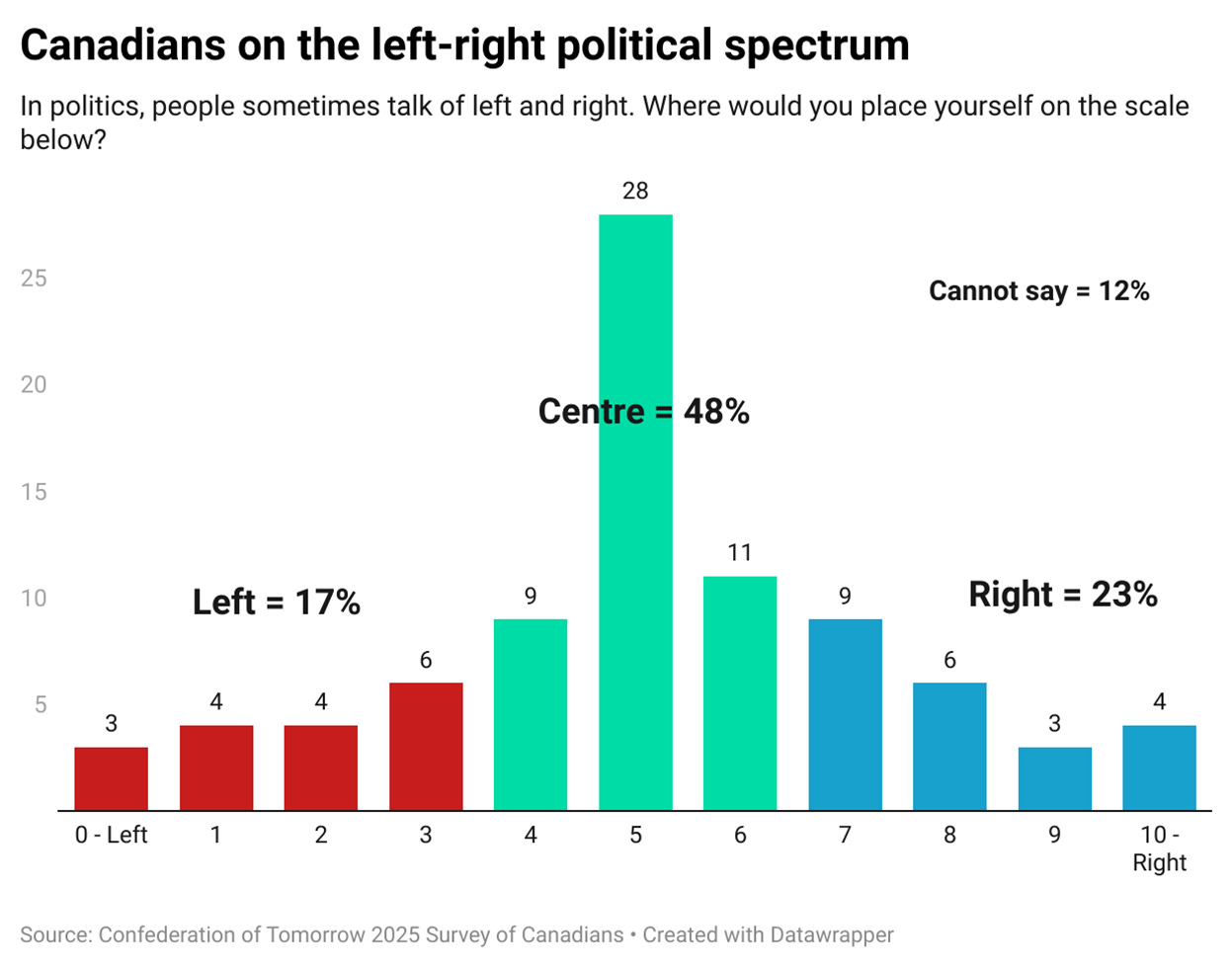
The Confederation of Tomorrow survey uses an 11-point political ideology scale that runs from 0 (furthest left) to 10 (furthest right). Most Canadians (48%) huddle around the mid-point, but about one in five place themselves on the left-hand (17%) or right-hand (23%) sides of the scale. (There is a chart illustrating this at the end of this post.)
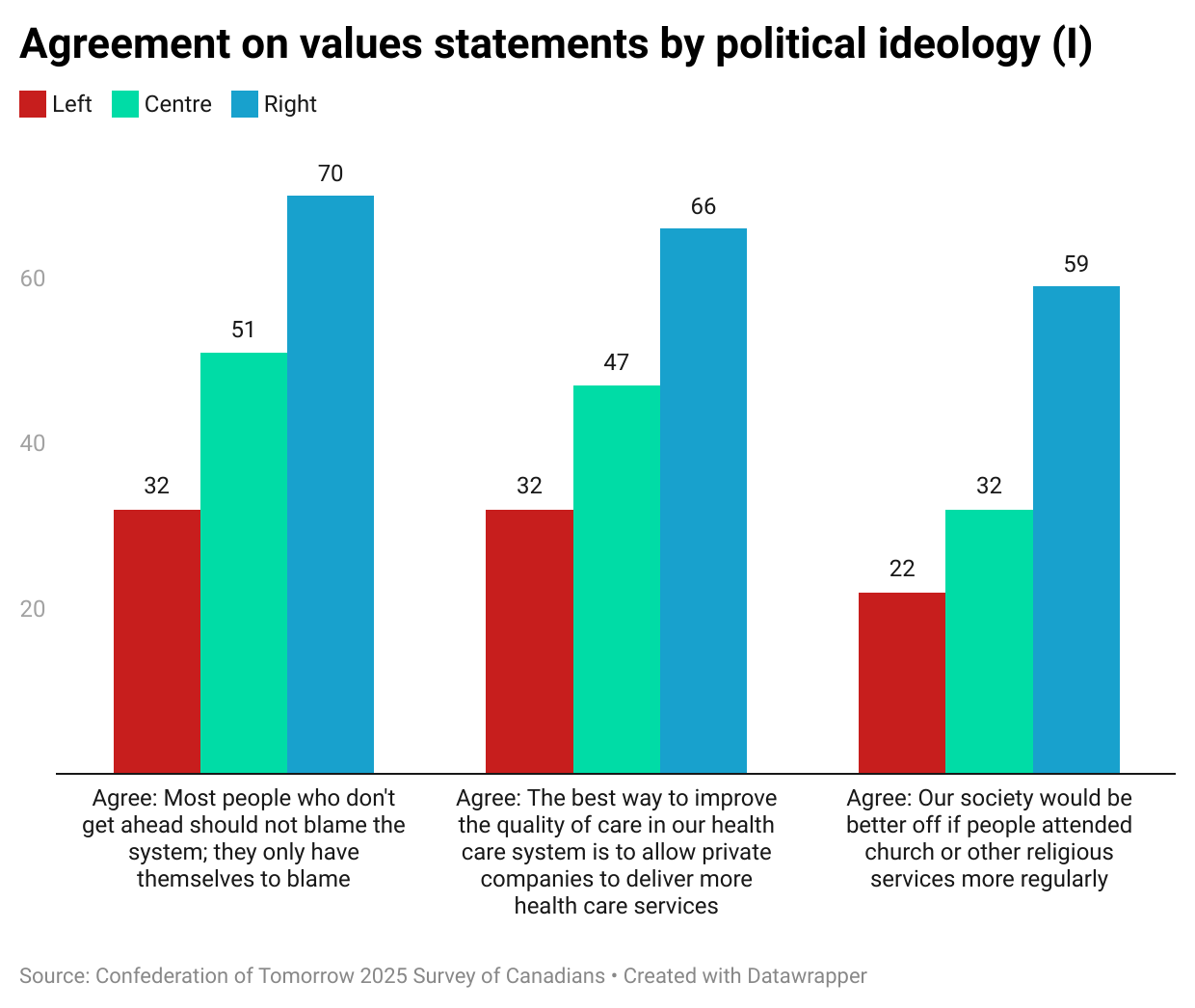
The survey also asks people to agree or disagree with a series of values statements, and it’s revealing to compare the answers of those on the left to those on the right. I’ll present the results for three statements at a time. (Note that, in some cases, I’m showing the proportion that agrees, and in some cases the proportion that disagrees, so that the figures for those on the right are always higher than for those on the left.)
The first group of statements is undoubtedly the least surprising. Canadians who place themselves on the right are much more likely than those on the left to hold individuals rather than the system responsible for any failure to get ahead, are much more open to a role for the private sector in health care delivery, and are much more traditional in their thinking about the place of religion in society. In each case, agreement among those on the right outweighs agreement among those on the left by at least a two-to-one margin.
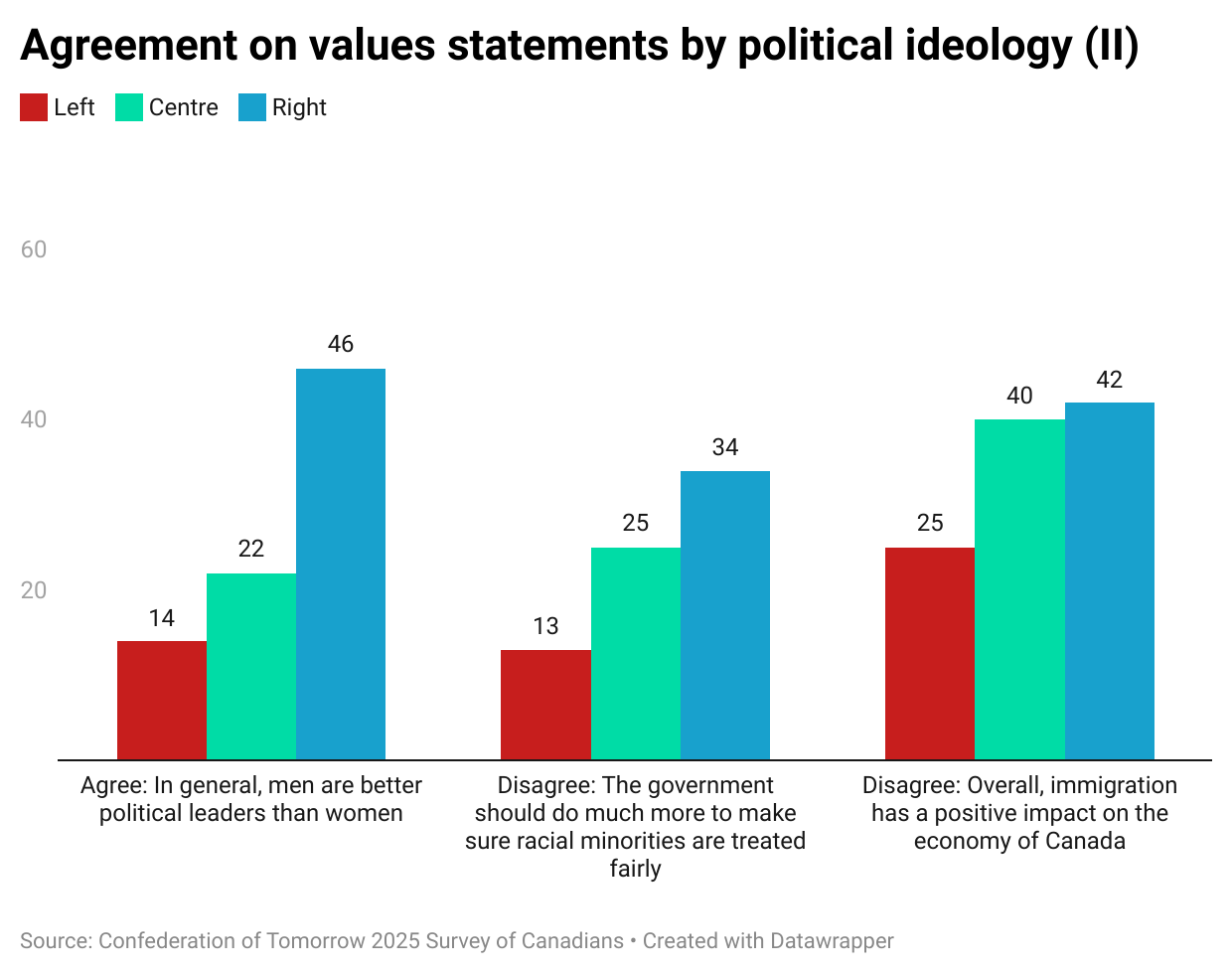
The next set of three statements covers gender equality, the treatment of racial minorities and the economic impact of immigration. Yes, people on the right have more traditional views on gender roles and are more skeptical of the need for the government to intervene to protect racial minorities. But there are several nuances worth noting.
First, the right-left difference is much bigger on the issue of gender equality than on the treatment of racial minorities.
Second, on the treatment of racial minorities, majorities of both those on the right and the left are on the same side of the issue. Agreement that the government should do more to make sure racial minorities are treated fairly is higher among those on the left (80%), but 60 percent of people on the right also agree.
Third, while those on the right currently have more doubts about the economic benefits of immigration, they are not outliers on this issue – their opinions resemble those of the largest group of Canadians, namely those in the centre.
Here’s the final set of three statements.
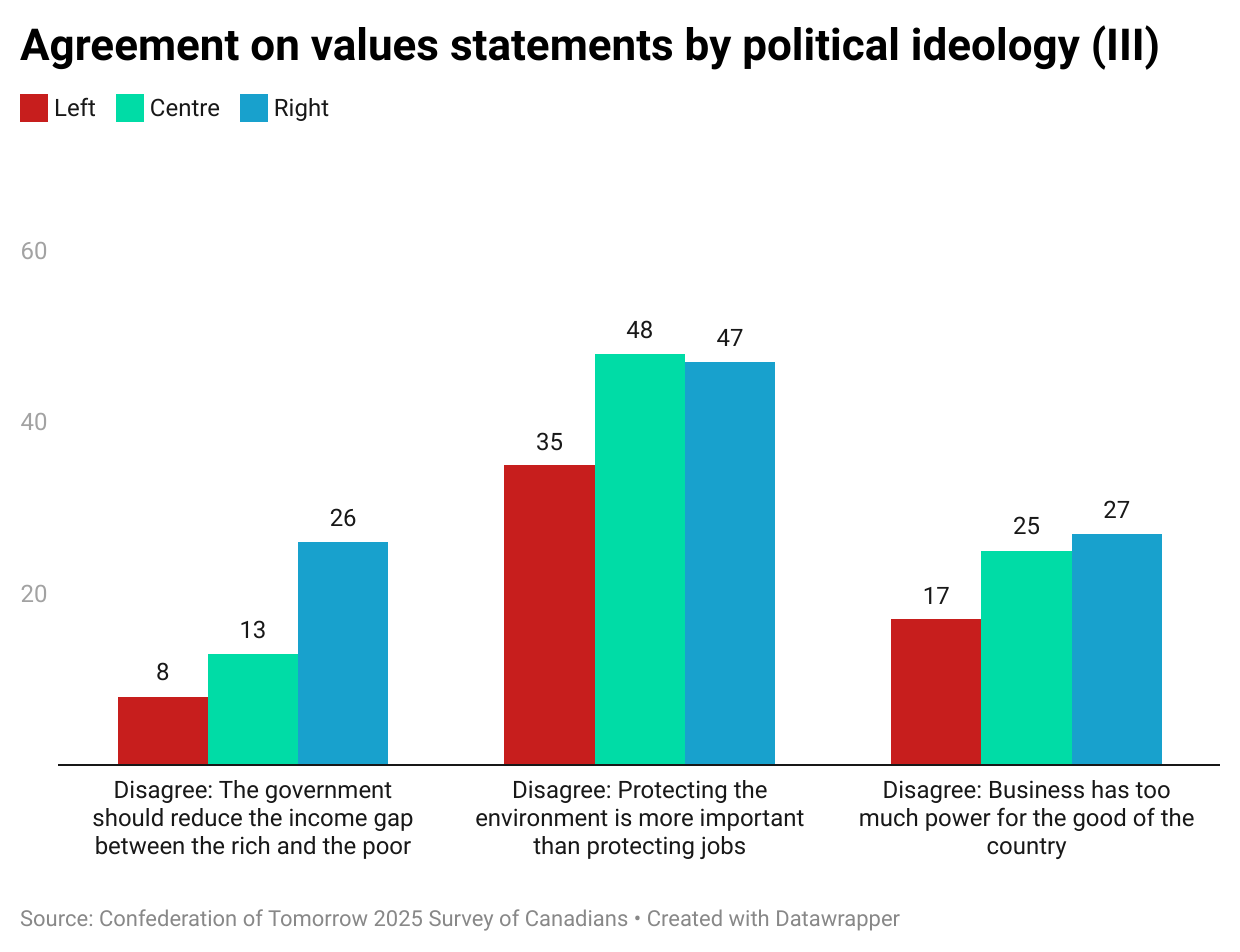
This is a more eclectic trio of statements, so I will take each one in turn.
Opinions on economic inequality resemble those on the treatment of minorities. Yes, those on the right are more likely to disagree that governments should reduce the gap between rich and poor, but most nonetheless agree. Again, majorities of both those on the left (89%) and right (69%) are on the same side of this issue.
Opinions on whether protecting the environment is more important than protecting jobs resemble those on immigration: it’s not those on the right who are outliers, but those on the left (to a certain extent, at least). This isn’t about who’s right or wrong; just an observation about who’s currently closer to the centre ground.
Finally, the question with the smallest left-right gap in opinion relates to the power of business. Only a minority across the spectrum disagrees – which, again, means that majorities of both those on the left (71%) and on the right (66%) agree that business has too much power for the good of the country.
Now to sum this up. Some left-right differences seem to match most people’s expectations: for instance, the ones relating to religion, personal responsibility or health care reform. But there are only relatively modest gaps in the case of two questions about equality: the ones about the treatment of racial minorities and about income gaps. Views on gender equality, rather than on other forms of equality, seem to capture more of the difference between left and right today.
There are left-right differences in opinion on other policy issues, such as the environment and immigration. But the fact that those on the right are currently closer to the centre on these issues may help to explain some of the policy adjustments we’ve recently seen from Ottawa.
Finally, people on the right are almost as distrustful as those on the left of the power of business. We’re used to thinking about right-wing populism in terms of a criticism of political, media or university elites – but the criticism of business interests is no less an important feature (for more on this, see my earlier post, Understanding Today’s Conservatives).
This post features data from the 2025 Confederation of Tomorrow Survey of Canadians. The author is solely responsible for any errors in presentation or interpretation.
The Confederation of Tomorrow surveys give voice to Canadians about the major issues shaping the future of the federation and their political communities. They are conducted annually by an association of the country’s leading public policy and socio-economic research organizations: the Environics Institute for Survey Research, the Centre of Excellence on the Canadian Federation, the Canada West Foundation, the Centre D’Analyse Politique – Constitution et Fédéralisme, the Brian Mulroney Institute of Government and the First Nations Financial Management Board.
The 2025 study consists of a survey of 5,391 adults, conducted between May 1 and June 16, 2025 (92% of the responses were collected between May 6 and May 29); 90 percent of the responses were collected online. The remaining responses were collected by telephone (both landline and cell phone) from respondents living in the North or on First Nations reserves, or from francophone respondents in New Brunswick.
Appendix chart
What is the Environics Institute for Survey Research? Find out by clicking here.
Follow us on other platforms:
Bluesky: @parkinac.bsky.social
Twitter: @Environics_Inst or @parkinac
Instagram and Threads: environics.institute
Photo credit: Mikhail Nilov
Nice selection of questions along with the analysis. Less polarization in some areas.
Great read. Are there any significant regional variations on the first set of values questions: getting ahead, healthcare, and attending religious services?