

Freedom vs. equality: which do Canadians consider more important?
Part one of a new series on political values

Liberal democracies promise their citizens the freedom to live their lives according to their needs and interests. This promise entails freedom in the sense of both the absence of restraints, and the absence of obstacles or unjust barriers. Genuine freedom implies equality of opportunity, that is, an equal chance to exercise freedom. A society in which some are prevented from realizing their potential because of gender, racial or other forms of discrimination fails to deliver on the promise of freedom.
Accordingly, both freedom and equality are important. But which is more important to you?
This is a question we recently put to Canadians. Specifically, we asked them which of two statements comes closest to their own opinion:
Both freedom and equality are important. But I consider personal freedom to be more important, that is, everyone can live in freedom and develop without hindrance.
Both freedom and equality are important. But I consider equality to be more important, that is, nobody is underprivileged and social class differences are not so strong.
The first thing you should do is close your eyes and guess how Canadians responded before you read the results in the next paragraph. What proportion do you think considers personal freedom more important, and what proportion considers equality more important? Let me know in the comments if you guessed correctly (or not).
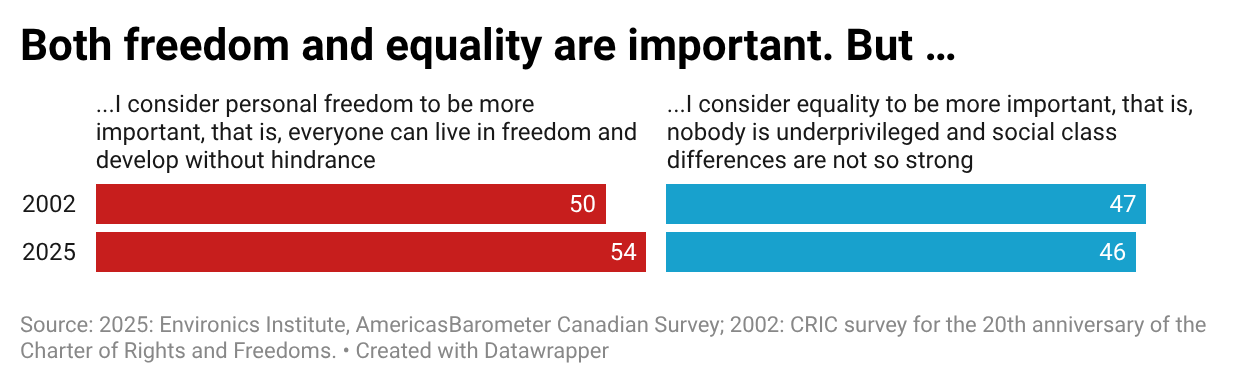
The actual result is not quite 50-50, but close: 54 percent of Canadians say personal freedom is more important; 46 percent say equality is more important. By a fairly slim margin, Canadians are more likely to consider freedom to be more important, but almost as many favour equality.
Changes over time
Let’s explore this result in more detail. The first point to note is that opinions haven’t changed much over the past two decades. This question was asked once before, in 2002, at the time of the 20th anniversary of the Charter of Rights and Freedoms.1 The results were very close to those from 2025.2 Over time, the preference for freedom over equality has widened marginally, from three percentage points to eight. But then, as now, our society as a whole was fairly evenly divided between those of us who lean more toward freedom, and those of us who lean more toward equality.
Age and gender differences
Next, we look at how responses vary across the population. First, there are differences to note both by age and by gender. In 2025:
Women (51%) are 10 percentage points more likely than men (41%) to say they consider equality more important; conversely, men (59%) are more likely than women (49%) to say they consider freedom more important. Another way to put this is to say that men lean more toward freedom than equality (a difference of 18 points), whereas women are evenly divided between the two values (a negligible 2-point difference).
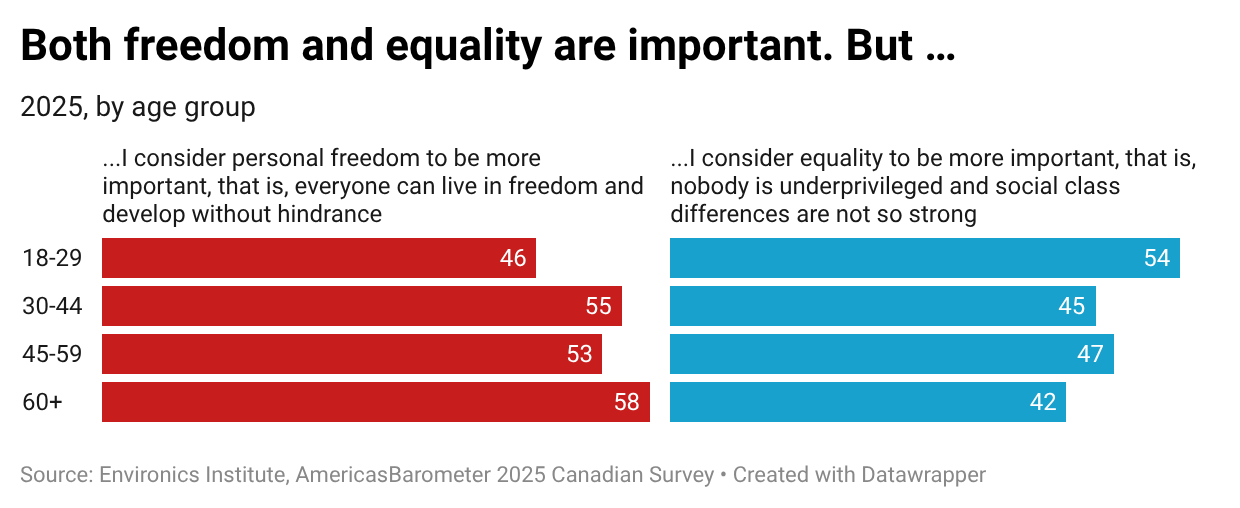
Younger adults – those between the ages of 18 and 29 – lean more toward equality (54%) than freedom (46%), though by a modest margin of only eight points. All other age groups (age 30 and older) lean more toward freedom than equality, with the gap reaching 16 points among those age 60 and older.
As is often the case, it gets even more interesting when age and gender are combined.
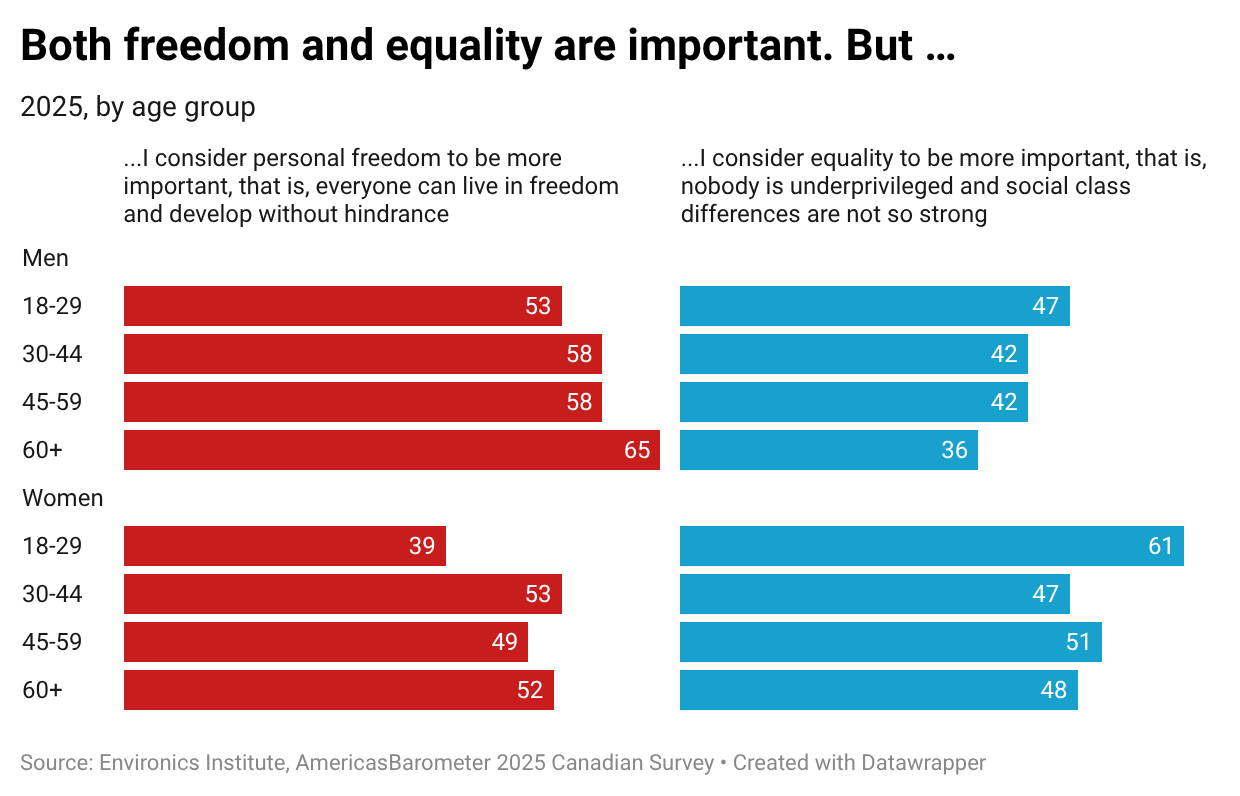
Men in every age group are more likely to favour freedom over equality, but the gap widens from only six points among younger men, to 29 points amount older men.
Younger women heavily favour equality over freedom (a gap of 22 points), whereas women in each age group older than 30 are more evenly divided between the two values.
The upshot of this is that the biggest difference in opinions is between freedom-loving older men, and equality-loving younger women.
The gender gap is more or less the same today as it was more than 20 years ago (in 2002), with women leaning a little more toward equality than toward freedom, and the reverse being the case for men. The age difference, however, has become more pronounced. In fact, there was no significant difference in opinion across age groups in 2002, with each group being evenly split between the two perspectives. But compared to then, the youngest age group has moved a little more toward equality, and the oldest age group more toward freedom – opening up the age gap mentioned earlier.
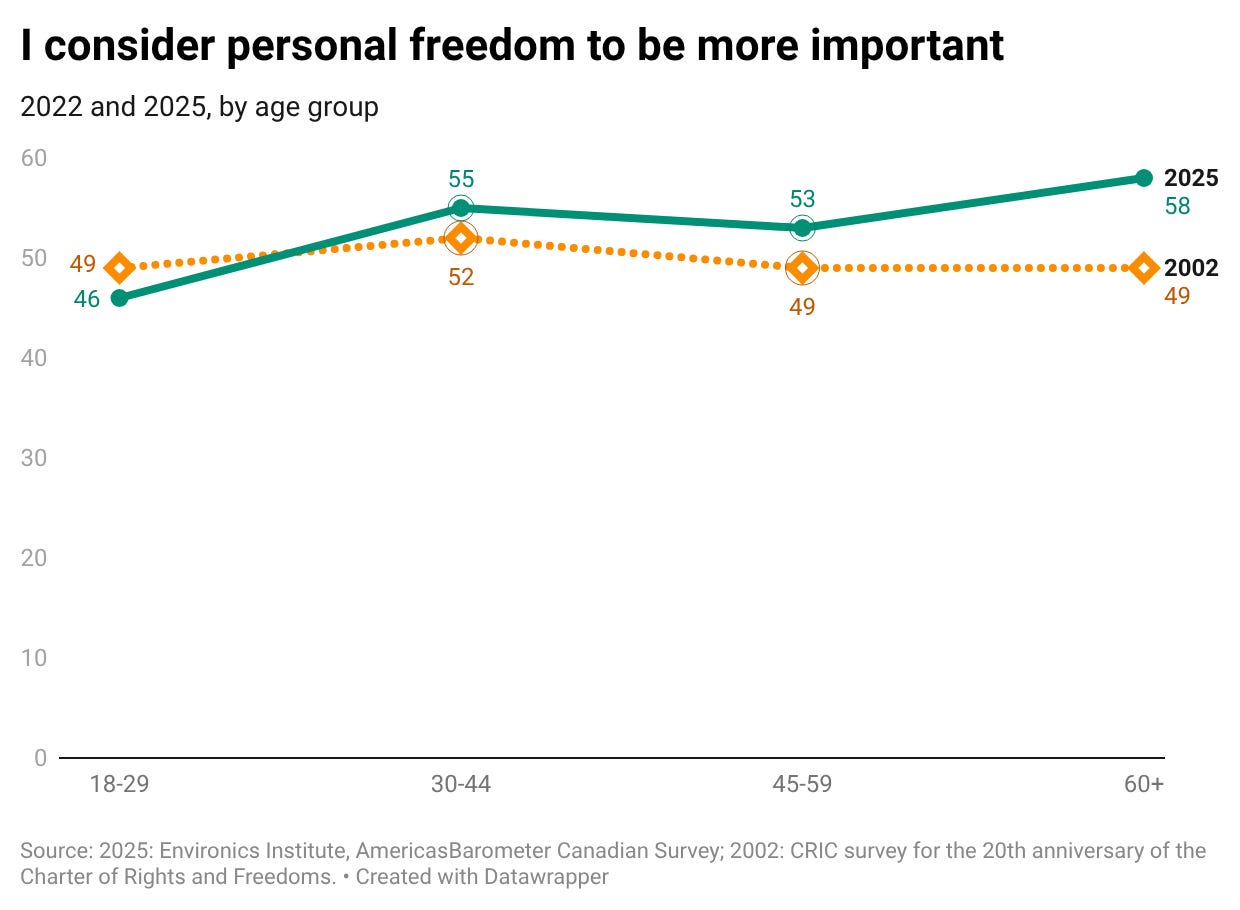
Among older Canadians, this increased likelihood (over time) of selecting freedom as more important appears to be more pronounced among older men than older women.3 This is important mainly because it offers another reason to be cautious about claims that younger men and women are drifting further apart on political issues. On this question, at least, that is not the case. It is older rather than younger men who appear to have shifted their opinions.4
There are so many different angles to cover when exploring results to this question that I’ve decided to turn this into a series. The next part will compare opinions in Quebec to those in the rest of the country. I’ll eventually update this edition of the newsletter to include the links of all the parts of the series here.
Update: Part 2 on Quebec and the rest of Canada now available.
This post features data from the AmericasBarometer 2025 Canadian Survey. Results from this survey are posted on our website.
The AmericasBarometer is a regular comparative survey of democratic values and behaviours that covers countries in North, Central and South America, as well as a significant number of countries in the Caribbean (the 2025-26 study will cover 20 countries). The project is led by the LAPOP Lab at Vanderbilt University’s Center for Global Democracy (CGD). The Canadian survey was conducted by the Environics Institute for Survey Research, in partnership with CGD’s LAPOP Lab at Vanderbilt University and with the support of the Max Bell Foundation. The author is solely responsible for any errors in presentation or interpretation.
The survey was conducted online with a sample of 3,550 Canadians (aged 18 and over) between July 30 and August 7, 2025. The results are weighted by region, age, gender, education and language so as to be fully representative of the Canadian population.
What is the Environics Institute for Survey Research? Find out by clicking here.
Follow us on other platforms:
Bluesky: @parkinac.bsky.social
Twitter: @Environics_Inst or @parkinac
Instagram and Threads: environics.institute
You can find the report from the 2002 survey in the collection of materials we posted for the 40th anniversary of the Charter in 2022; scroll to the bottom of this webpage: https://www.environicsinstitute.org/projects/project-details/confederation-of-tomorrow-2022-survey-of-canadians.
In 2002, three percent said they don’t know or didn’t answer. The 2002 survey was conducted by telephone; on telephone surveys, “don’t know” is a volunteered rather than a prompted response. The 2025 survey was conducted online. In the AmericasBarometer online surveys, there is no “don’t know” option. There is a “decline to answer” option, but it is hidden and only appears if the respondent clicks to advance to the next question without providing an answer. This technique results in either few or no “decline” responses.
Since the total sample size in 2002 (1,402) is smaller than in 2025 (3,550), we have to be more cautious with the combined age and gender breakdowns.
It is perhaps more accurate to say that middle-aged men have shifted their opinions, since those age 60 and older today were aged 37 and older in 2002.
I went 60-40 in favour of equality, perhaps partly because that's my preference and I suspect many of my peers would be similar, having me falsely weigh that side more heavily, I guess.
I had guessed that 60% preferred freedom and 40% preferred equality. The age and gender differences are interesting and in some ways not surprising. I associate equality with a more left leaning politics and freedom with a more right leaning politics. Your study seems to mirror other data on the left-right split between women and men. I consider myself centre-left (to which I now have to add the words "whatever that means") but as an older male, I seem to fit your findings about gender and age. Thank you for your work on this and many other issues.