

What’s the most important problem facing Canadians today?
The differing priorities of younger and older generations

In 2023, as the immediate threat of the pandemic receded, the cost of living emerged as the top-of-mind issue facing Canadians. But, at the start of 2025, a new threat appeared: that posed by the return of Donald Trump to the White House, with his tariffs and interest in absorbing Canada into the United States.
It would be a mistake to assume that concerns about tariffs or annexation displaced those about the affordability of groceries, housing and other necessities. Both have remained high on the public’s agenda – though not everyone ranks them in the same order.
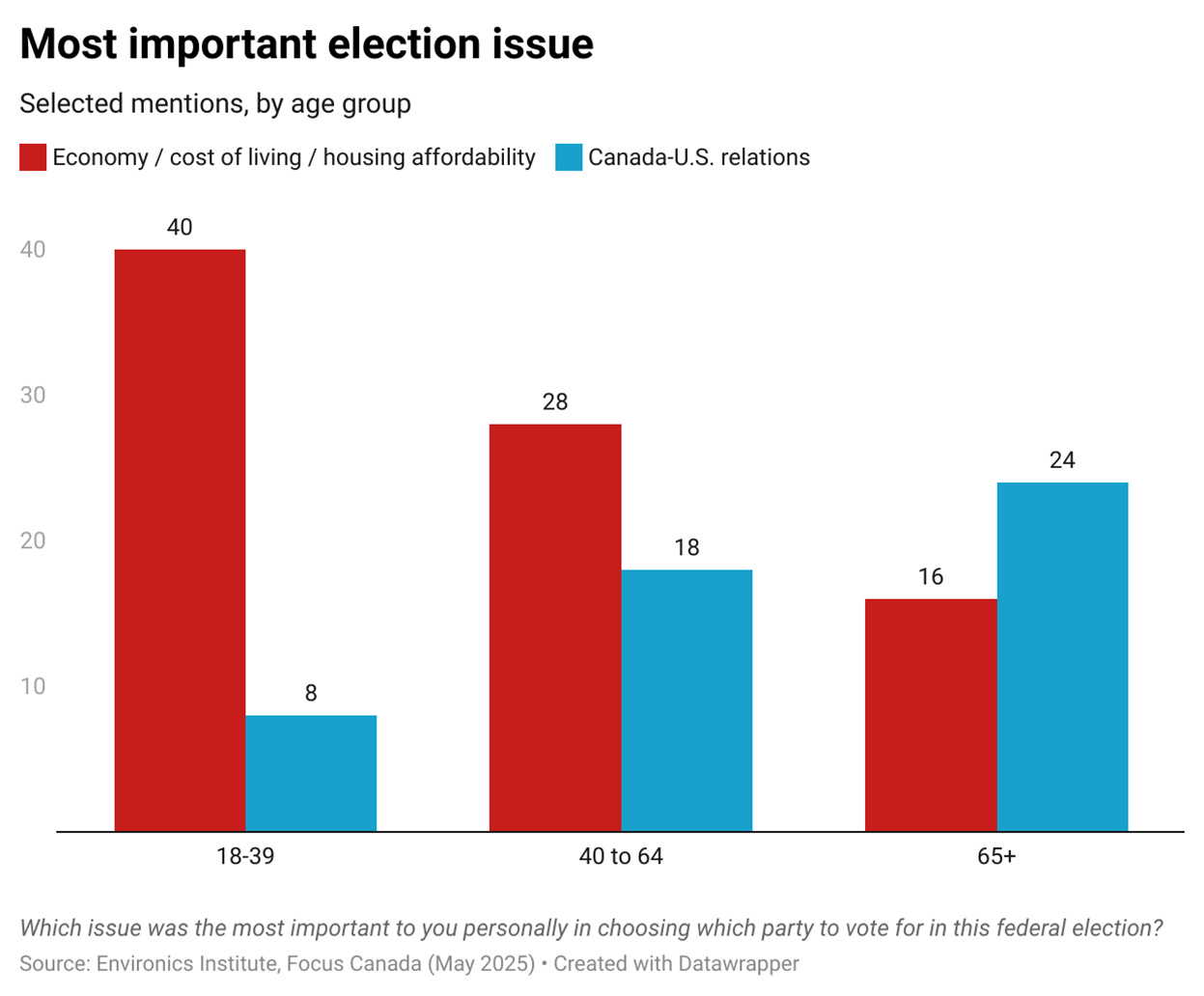
Here’s a reminder of what voters told us was the most important issue to them personally in choosing which party to vote for in the April federal election (from our May Focus Canada survey).

Read the full report: Ballot questions: which issues mattered most to voters in the 2025 federal election?
The question was open-ended (meaning that people could answer in their own words rather than selecting from a list of possible items), and only one answer was allowed. This means that the proportion choosing each issue may appear lower than expected; while voters might have had many concerns, the survey allowed them to name only the one that was most important to them in making their choice.1
Overall, despite the events upending Canada-U.S. relations, the issue most likely to be mentioned as most important by voters was the economy or the cost of living (25%). This was followed by Canada-U.S. relations (17%) and the positive appeal of the leader of the party supported (12%).
Of course, answers varied depending on which party a person voted for. Liberal Party voters were more likely to mention Canada-U.S. issues than economic or cost of living issues; the opposite is true for Conservative Party voters.
What’s more striking, though, is the differences among age groups. Younger voters (in this case, those between the ages of 18 and 39) were more than twice as likely as older voters (age 65 and older) to mention either the economy, the cost of living or housing affordability as their most important issue (40%, compared to 16%). By contrast, older voters were three times more likely than younger voters to mention Canada-U.S. relations (24%, compared to 8%).
The same pattern is evident if we turn to a different survey and a slightly different question. Each year, the Confederation of Tomorrow survey asks Canadians: “In your opinion, what is the most important problem facing Canadians today?” The 2025 survey was conducted in May. It’s worth throwing the results from this survey into the mix because they show how things have changed (a lot) over the past few years.
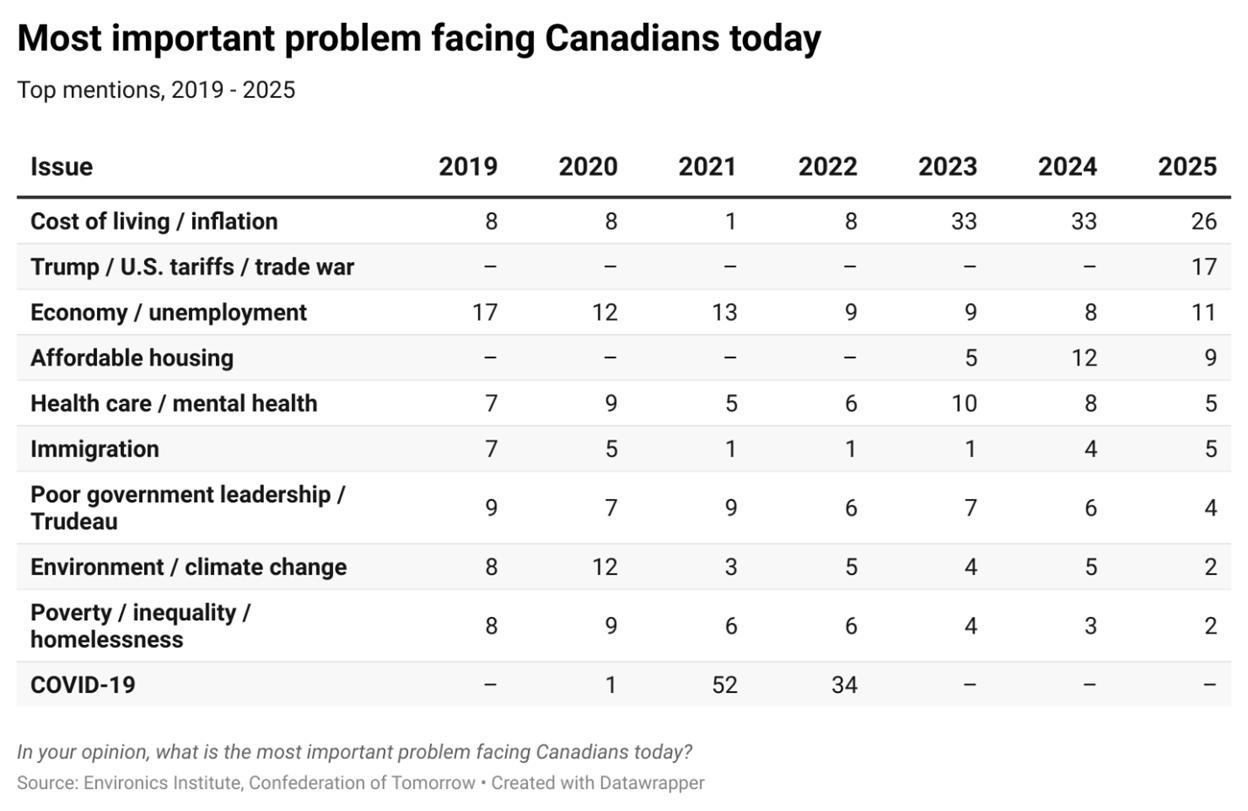
The format of this question is also open-ended; again, only one answer is allowed – so, the results are zero-sum: when one issue becomes more prominent (as COVID-19 did in 2021), the proportion naming other issues must necessarily decline.
This table illustrates the dramatic shifts we’ve been living through. Issues have jumped to the top of the list suddenly rather than gradually. This was the case for the pandemic.2 But it was also the case for inflation (in 2023) and then for Canada-U.S. relations (in 2025).3 It’s also the case, to a certain extent, with housing affordability: prior to 2023, it didn’t even register. Again, this doesn’t mean that no one was concerned about the cost of housing prior to 2023; it just means that, in an open-ended format, everyone named something else that was more concerning – their “most important problem” facing the country was something other than housing.
Getting back to my main point: notice that, while the Canada-U.S. trade war suddenly appears on the list in 2025, it doesn’t displace the cost of living as the more frequently mentioned concern.
Now let’s look at how this varies across age groups.
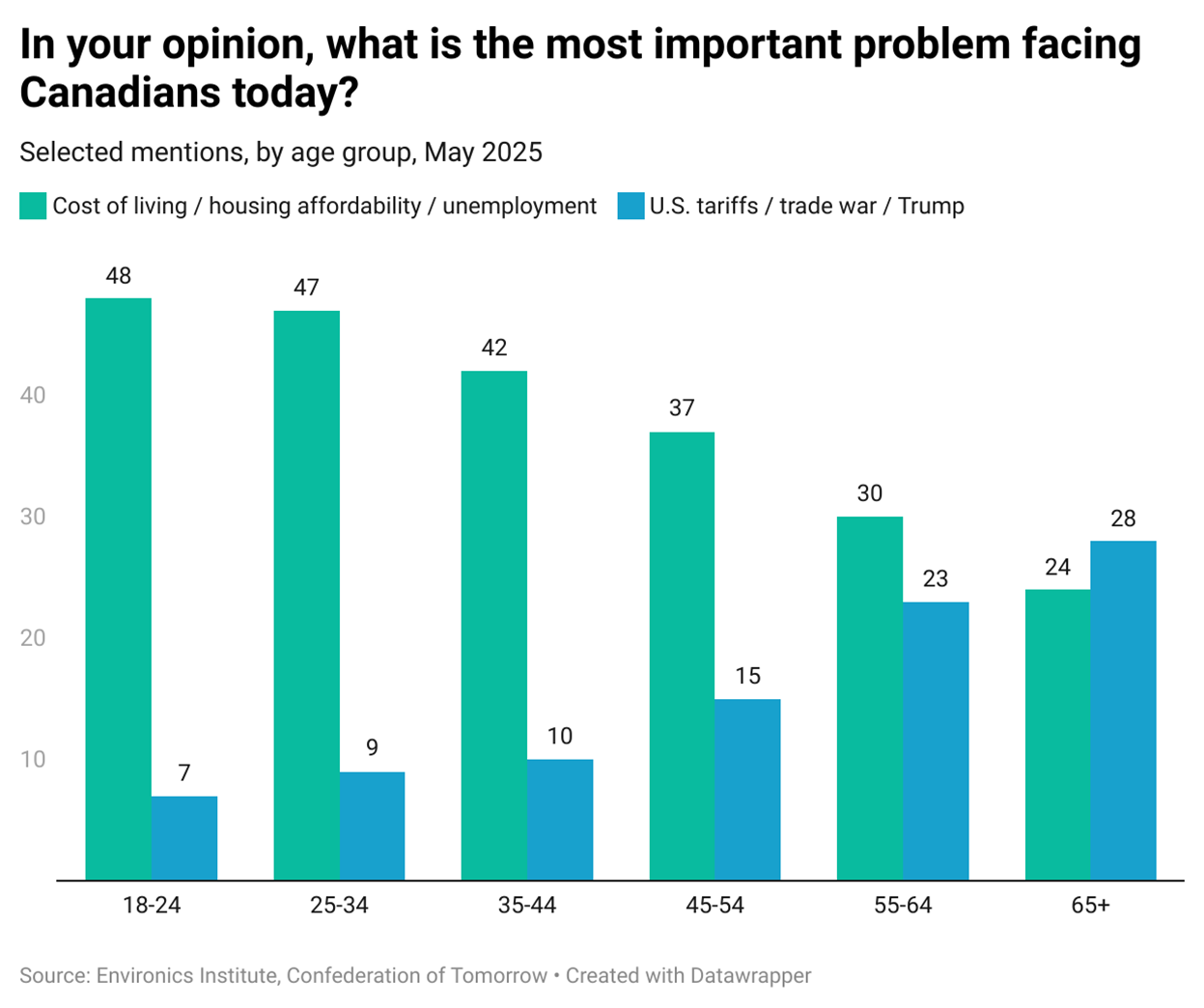
The younger you are, the more likely you are to mention the cost of living, the cost of housing or unemployment as the most important issue facing the country. The older you are, the more likely you are to mention something to do with Canada-U.S. relations. Only among those age 65 and older does the latter overtake the former.
In presenting these findings, my point is not to argue that some issues are actually more important than others. I certainly don’t want to imply that the threat currently posed by U.S. trade “policy” is not real, simply because that issue doesn’t land at the top of the list in a public opinion survey.
But I do want to underline that the crises emanating from Washington never really dislodged the public’s predominant concern with so-called pocketbook issues, including concerns about the cost of living and housing affordability. And furthermore, that consistently in 2025, the public’s priorities have varied significantly by age, with young adults much more concerned than seniors about issues such as affordability and unemployment. Any political party (or government) that overlooks these generational differences for too long is asking for trouble.
I’ll revisit this topic of the differing priorities of younger and older generations in the next edition of this newsletter, when I delve into some of the findings from a new landmark report on support for child care programs in Canada.
To preview the findings about generational differences in public spending priorities, read the full report: Public Support for Child Care Programs in Canada
The data in this post are from the Environics Institute’s Focus Canada and Confederation of Tomorrow surveys; details of the methodology of all our surveys are available on the Projects section of our website. Thanks to our survey project partners for making these studies possible.
What is the Environics Institute for Survey Research? Find out by clicking here.
Follow us on other platforms:
Bluesky: @parkinac.bsky.social
Twitter: @Environics_Inst or @parkinac
Instagram and Threads: environics.institute
Cover photo credit: OcusFocus
The question was asked to those who said they voted in the federal election held on April 28, 2025. As is typically the case with public opinion surveys, the proportion of people who say they voted is higher than the actual turnout.
The 2020 survey was conducted in January and February – at that time, only one percent of us had seen enough international news to know what was heading our way.
Admittedly, the fact that there are such sudden increases in the proportion naming an issue as the “most important problem” is partly a function of the format of the question, which allows only one answer. Obviously, many people thought that the cost of living was a problem before 2023; it’s just that few thought it was the single most important problem.