

Where does the CAQ fit in?
A short refresher on Quebec politics

I’m halfway through the four-part series on “freedom vs. equality”, but events have intruded. I’m interrupting the series to offer some insights into Quebec politics in the context of the premier’s decision to step down. We’ll get back to the series on political values next week.
The resignation of François Legault as Quebec premier and leader of the governing Coalition Avenir Québec (CAQ) was not unexpected, given how unpopular he and his party had become. But no one knows what to expect next. Not only is the race to succeed him fairly wide open, it’s unclear what effect (if any) a change of leadership will have on the province’s politics. A victory for the sovereigntist Parti Québécois in the fall election is still widely expected, but it would be unwise to take anything for granted until the dust settles on the CAQ’s leadership race, as well as – not to be overlooked – the ongoing search for a new leader of the Quebec Liberal Party.
Against this backdrop, it seems to be a good time to revisit some of the findings from the most recent Confederation of Tomorrow survey, as a reminder of what brought the CAQ success in the past, and the challenges the party faces going forward.
Every year in the survey, we ask Quebecers whether they consider themselves to be mainly a federalist, mainly a sovereigntist, someone who is in between the two, or someone who is neither one nor the other. The question was written in the early 2000s, in order to push beyond the traditional survey questions about Quebec politics that tended to offer only two options: yes or no to sovereignty.1
Here’s how the results stood in 2025:
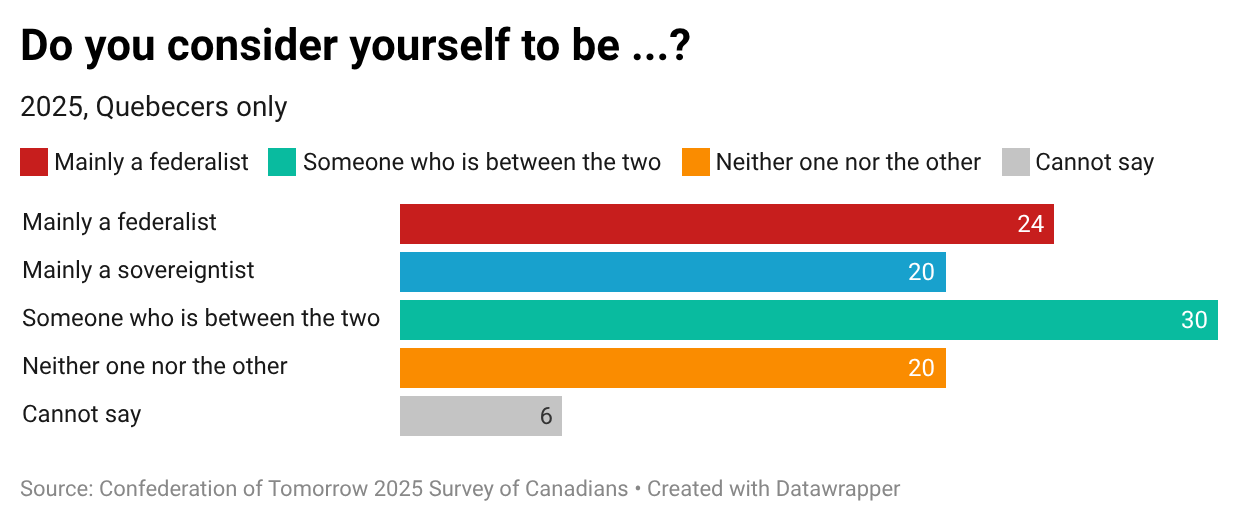
These results clearly illustrate the space in Quebec politics that the CAQ – up until now, at least – has successfully filled. While opinions are divided, the largest group of Quebec voters (30%) consider themselves to be in between the two options (federalist and sovereigntist), which is more or less the position that Legault has taken. An additional 20 percent opt for “neither.” Altogether, fewer than one in two Quebec voters consider themselves to be mainly a federalist or mainly a sovereigntist, which means the CAQ’s constitutional position (or non-position, or ambivalence, or ambiguity) aligns with that of the largest portion of the population.
For more analysis of the results to this question and the trajectory of Quebec politics, see the recent report by Charles Breton (Executive Director of the Centre for Excellence on the Canadian Federation): Trente ans après le référendum de 1995 : le Québec, le Canada et la question nationale.
This pattern is even clearer if we map provincial vote intentions according to these positions.
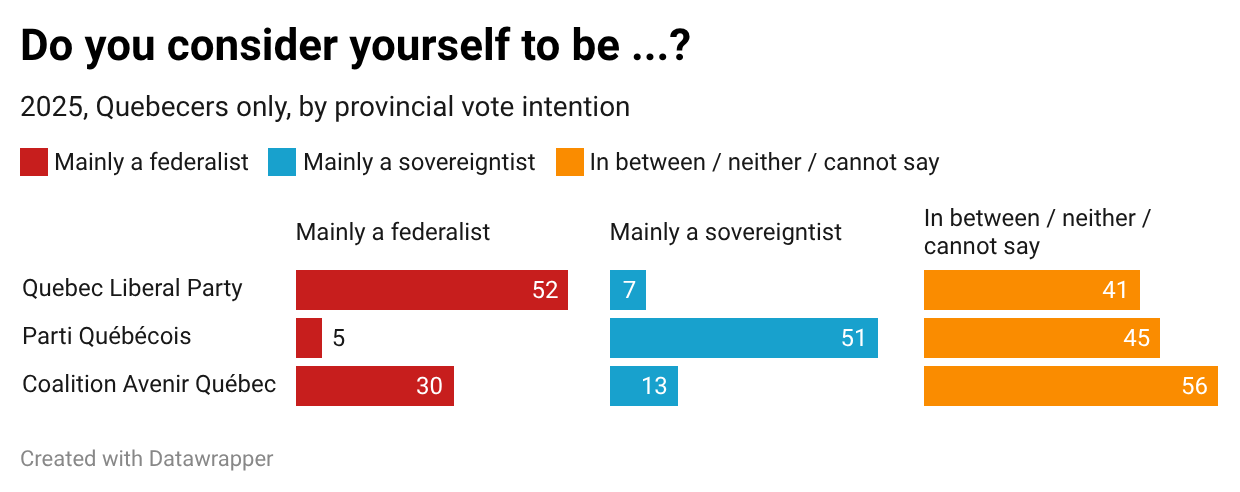
Not surprisingly, the largest group of voters who back the Quebec Liberal Party describe themselves as mainly federalist, and the largest group of the PQ’s supporters are mainly sovereigntist. But the largest share of the CAQ’s support comes from Quebecers who consider themselves to be in between or neither (or who take no position at all).
Paradoxically, the CAQ’s advantage is also its weakness: coalitions bring disparate pieces together, but there remains a risk that these pieces will come apart again. It can’t be taken for granted that Legault’s successor will be as successful in occupying the middle ground between federalism and sovereignty. A new leader who appears to lean more toward one side than the other will have a harder time holding onto the party’s more ambivalent base.
The other two main parties – the PLQ and the PQ – can also appeal to CAQ voters, particularly by talking about issues (such as the economy or health care) than don’t align with the federalism-sovereigntist debate. Naturally, it’s very difficult for the Liberals to make gains from those who consider themselves to be mainly sovereigntist; conversely, it’s unlikely that the PQ will gain support from the mainly federalist group. But both can set their sights on bringing back more of the “in-between” or “neither” voters into their camps.
I make no predictions as to how this will play out, except to say that the party that holds power in the province at the end of 2026 will be the one that succeeds in appealing to voters who don’t identify with either the federalist or the sovereigntist camps. The PQ faces a clear challenge in this regard, given its leader’s commitment to holding a referendum on sovereignty, but the promise of change may nonetheless allow it to reconnect with enough “in-between” or “neither” voters to win. The PLQ faces no less of a challenge, due both to perceptions that the party is too soft on issues relating to the French language and provincial autonomy; and to its brand, which has been tainted by corruption scandals. The CAQ faces the challenge of having accumulated blame for everything that’s gone wrong during its years in government, but – as we have seen at the federal level – new leaders can sometimes succeed in resetting the narrative.
This is a recipe for volatility. Expect the unexpected.
This post features data from the 2025 Confederation of Tomorrow Survey of Canadians. The authors are solely responsible for any errors in presentation or interpretation.
The Confederation of Tomorrow surveys give voice to Canadians about the major issues shaping the future of the federation and their political communities. They are conducted annually by an association of the country’s leading public policy and socio-economic research organizations: the Environics Institute for Survey Research, the Centre of Excellence on the Canadian Federation, the Canada West Foundation, the Centre D’Analyse Politique – Constitution et Fédéralisme, the Brian Mulroney Institute of Government and the First Nations Financial Management Board.
The 2025 study consists of a survey of 5,391 adults, conducted between May 1 and June 16, 2025 (92% of the responses were collected between May 6 and May 29); 90% of the responses were collected online. The remaining responses were collected by telephone (both landline and cell phone) from respondents living in the North or on First Nations reserves, or from francophone respondents in New Brunswick.
What is the Environics Institute for Survey Research? Find out by clicking here.
Follow us on other platforms:
Bluesky: @parkinac.bsky.social
Twitter: @Environics_Inst or @parkinac
Instagram and Threads: environics.institute
Photo credit: Serhej Calka
The question was written by Maurice Pinard. Every time I use the question, I like to add at least a footnote to acknowledge Maurice’s contribution.